ESSAY · 07
Can We Believe in the Impossible Without Losing the Ability to Distinguish What Is Real?
Through the Looking-Glass, the White Queen, and the Limits of Transformative Imagination
When imagination opens the possibility of something new — and why belief alone is not enough to make it real
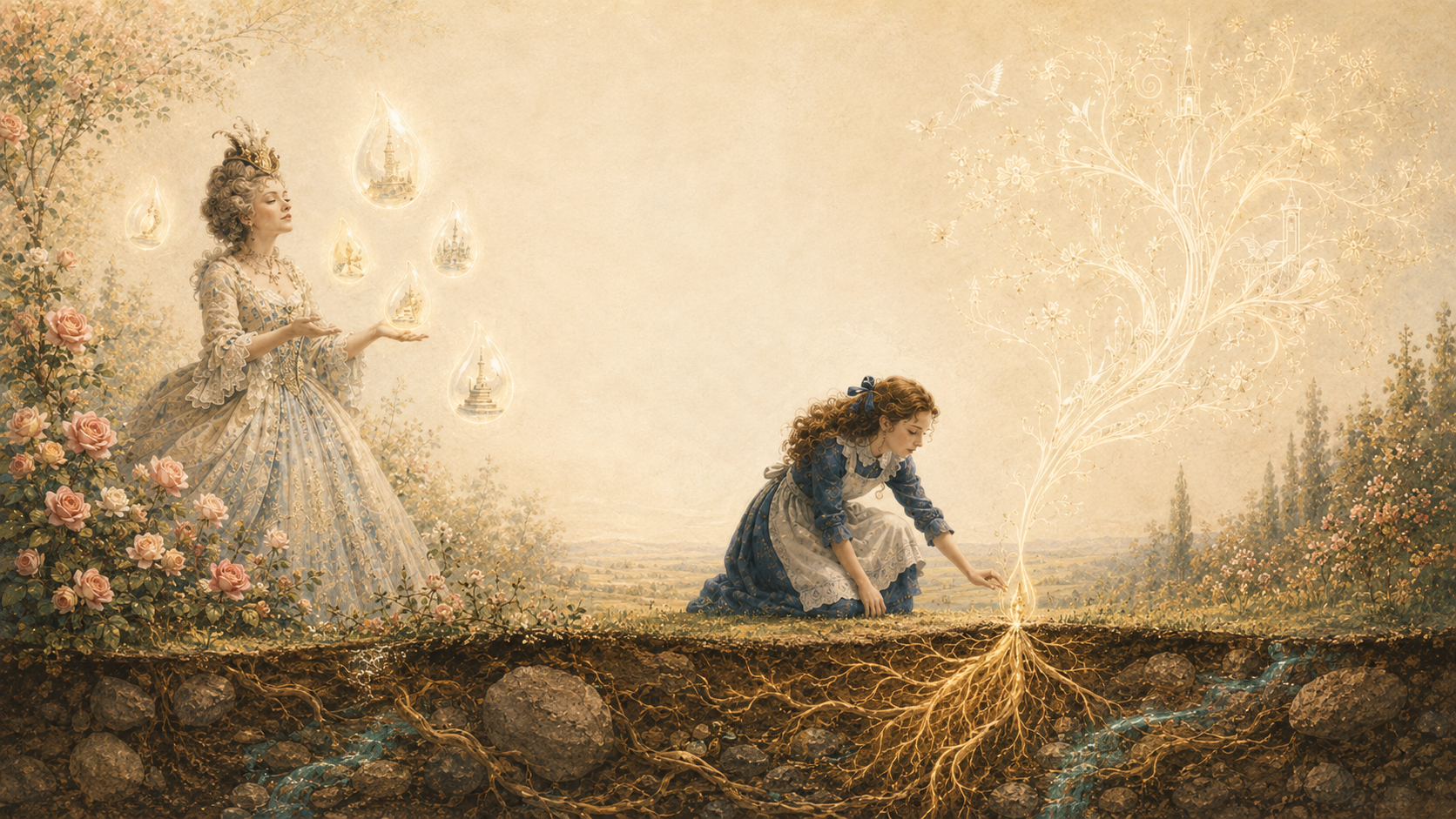
The White Queen and Alice between imagination and reality—an illustration for an essay on transformative imagination, reality testing, and human self-formation.
A person can direct themselves not only toward what already exists. They can imagine a skill they have not yet acquired, a different way of living, an unknown solution, or a state of being they have never experienced before. In this way, the present ceases to be the only form the possible can take.
This capacity matters not only for the individual. Without it, new ways of life, discoveries, inventions, and changes in the social order would never arise. Before something created by human beings can become reality, it must first appear as an image of possibility — sometimes in defiance of everything previous experience allowed them to regard as achievable.
But imagining a possibility does not yet prove that it can be realized. An image opens a direction, but it does not confirm that the path found is the right one, that the necessary conditions already exist, or that reality is obliged to conform to the original conception. The risk does not arise from imagination itself. It arises when a person stops distinguishing between what is desired, what is possible, and what is real — and, instead of testing the image they have created, demands that it already be treated as confirmed.
Possibility then ceases to be the beginning of transforming reality and becomes a way of avoiding an encounter with it.
Humanity moves forward not because it believes only in what is already real, and not because it mistakes the imagined for reality, but because it is capable of turning what does not yet exist into an object of inquiry, action, and testing.
The question, therefore, is not whether it is useful to believe in the impossible. The word impossible itself conceals very different things. It can refer to a logical contradiction, to something unsupported by facts, or to a problem for which no solution has yet been found. The same word can be used by society to describe a path not provided for by the existing order, or by a person to describe a future into which they are afraid to invest effort.
One kind of “impossible” requires us to recognize a limit. Another requires us to test an assumption. A third requires us to create conditions that do not yet exist. And sometimes something is called impossible only because the present is being treated as the final boundary.
In Through the Looking-Glass, the White Queen encourages Alice to practise believing. When Alice says that one cannot believe impossible things, the Queen replies that she simply has not had enough practice: the Queen herself has sometimes managed to believe as many as six impossible things before breakfast.
This line is often turned into a celebration of unlimited imagination. But it can be read as a more difficult question: what capacity does a person actually need in order to move beyond what already exists while still allowing reality to correct their understanding?
Through the Looking-Glass is not a source of the concept of Human Self-Formative Capacity, nor is it used here as evidence of its scientific validity. The conversation with the White Queen serves as a literary lens through which to examine the role of imagination in HSFC: how can an image of something that does not yet exist participate in a person’s formation — and where does transformative possibility give way to self-deception?
Reality Shows the Present but Does Not Exhaust the Possible
Every significant change is absent from reality at first. The skill has not yet been acquired. The solution has not yet been found. The new order has not yet been built. A person has not yet become who they are trying to become.
If we recognize as possible only what has already been confirmed by past experience, development becomes confined within repetition. A person can choose only among familiar ways of acting, evaluate themselves only by qualities they have already displayed, and treat every departure from their previous self-image as evidence that a different future is impossible.
So-called realism then ceases to be attention to reality. It becomes loyalty to its current form.
But the present does not contain a ready-made inventory of everything that can emerge from it. It shows us conditions, limitations, and consequences. Yet it does not decide for a person which conditions should be accepted, which can be changed, or for the sake of what it is worth creating a possibility that does not yet exist.
A person who has never spoken in public has no proof that they will become a confident speaker. The author of a new idea cannot present evidence in advance that it will one day be recognized. Someone who wants to change a habitual way of acting will find no confirmation of the new in their previous behaviour. If the past is given exclusive authority to determine the future, it begins to reproduce itself. What is different cannot yet point to evidence of its own existence.
Imagination breaks this closed circle. It allows us to relate to what is absent not as an already existing reality, but as a possible direction. Through imagination, a person can see the gap between what is and what could be.
That gap does not refute reality. It turns reality into material for change.
To Imagine Is Not to Believe
The White Queen speaks specifically about belief, but for self-formation it is important to distinguish several inner acts that are easily confused.
To imagine a possibility is to allow it into thought. To desire it is to experience it as valuable. To believe in it is to regard it, in some sense, as true or achievable. To decide is to connect it with subsequent action. None of these transitions happens automatically.
A person may imagine a beautiful future without believing it is attainable. They may believe in success without making a single decision. They may desire change while continuing to act in ways that make it impossible. They may begin to act without certainty, treating the possibility not as a promise of an outcome but as a hypothesis worth testing.
The ability to imagine clearly what does not yet exist is valuable precisely because it does not require us to declare it real. Imagination creates a space in which a possibility can be considered before it becomes a belief or a commitment.
If that interval disappears, the image quickly turns into a claim. “I can try to create this” becomes “this will definitely happen.” “I want to become different” becomes “I already am.” “The existing order can be changed” becomes “my idea of the new order must be right.”
A person may then begin to feel that doubt weakens the possibility. In reality, the possibility loses its capacity to develop precisely because it is no longer allowed to be tested.
Imagination opens a question. Blind belief closes it with an answer reached before any encounter with reality.
When “Impossible” Protects the Existing Order
Not every appeal to reality comes from knowing its limits. Sometimes the word “impossible” simply means: it has not been done here before; it does not fit the accepted role; the system does not know how to accommodate such an action; success cannot be guaranteed; people around us find it difficult to imagine a different order.
A family may consider a life that does not repeat the parents’ path impossible. A professional environment may consider an idea impossible when it comes from someone without recognized status. An organization may consider a way of working impossible when it disrupts its familiar hierarchy. A person may call impossible what they would have to take responsibility for without external approval.
In such cases, the claim of impossibility does not describe reality neutrally. It helps preserve it. If no one begins to act beyond what has already been confirmed, the absence of examples perpetuates itself as evidence that no such example is possible.
But this does not mean that every rejected idea is a hidden future. The environment may be wrong, but it may also see limitations that the person underestimates. Another person’s doubt may sometimes defend the familiar order, and at other times provide important information about the cost, risk, or weaknesses of an idea.
Independent reworking does not require choosing between one’s own vision and someone else’s skepticism. Both can become material for understanding. What exactly is being called impossible? What condition is missing? Is this a fundamental limit or a problem that has not yet been solved? What might change the assessment? What kind of test would distinguish a new possibility from an attractive assumption?
The question “why not?” opens a space. The question “what would need to become true for this to be possible?” begins to build a path within it.
Why Positive Certainty Can Stop Development
Certainty is often seen as the opposite of passivity. It can seem that a person who believes in themselves and in their future is already closer to change than someone who doubts. But conviction can support action, and it can also replace it.
If it is enough to call oneself capable, successful, or changed, the new self-image begins to protect the person from inconvenient facts. They no longer need to examine the gap between what is desired and what is real. Any failure can be explained by insufficient belief, the negativity of others, or temporary resistance from the world. The more strongly the facts contradict the image, the more insistently the person reaffirms it.
Belief then becomes a system that is resistant to disconfirmation. It no longer helps a person rework experience, because it determines in advance what meaning that experience is allowed to have.
For HSFC, this is a fundamental limitation. A person is not participating in their own formation if the image of the future serves only to preserve a pleasing understanding of themselves. Even constant activity changes nothing when actions merely confirm the existing belief. Feedback then remains unable to change the path, the goal, or the person’s assessment of their own capacities.
Transformative belief differs not in the strength of its certainty, but in how it relates to reality. It can sustain action before a result appears, but it does not require the result to be treated as guaranteed. It allows a person to say: “This does not exist yet; I do not know whether it will work; but I see enough reason to begin and learn more.”
This is not weak belief. It is belief that does not need to deny uncertainty.
Doubt Can Also Protect a Person from Reality
If unsupported certainty can stop development, it is easy to draw the opposite conclusion: that it is reasonable to believe only in what has already been confirmed. But caution can also become a way of avoiding a test.
A person may say that they are waiting for complete clarity when, in reality, they do not want to face the possibility of failure. They may demand guarantees where knowledge can emerge only after action. They may call themselves realistic while using the past to protect themselves from responsibility for the future.
Such doubt may appear intellectually honest, but it is structured in the same way as blind belief. It excludes in advance the experience that might change it. In one case, a person refuses to allow facts to disconfirm the possibility. In the other, they fail to generate the evidence that might confirm it.
Both patterns keep the person unchanged. One allows them to live inside an imagined outcome; the other, inside a supposedly proven impossibility. Both protect them from the hardest transition: turning an uncertain possibility into action whose consequences cannot be fully controlled.
The willingness to doubt, therefore, does not by itself guarantee openness to reality. What matters is whether doubt leads to clarification and testing, or becomes a final reason not to begin at all.
The Future Image as a Formative Demand
An imagined future can influence the present before it becomes real. The image of who a person might become makes new distinctions visible in their present experience. What once seemed insignificant may begin to appear as an obstacle, a resource, or a mismatch.
If a person imagines themselves capable of speaking truthfully in difficult circumstances, they may begin to see their habitual concessions differently. If they want to create work that does not yet exist, they may evaluate knowledge, time, and ways of interacting differently. If they allow for a different order of relationships, what once seemed “normal” may for the first time appear as a choice rather than an inevitability.
In this sense, the future image does more than comfort or motivate. It poses a question to the present: what in my way of understanding and acting must change for this possibility to become more than something imagined?
But the answer cannot be obtained from the image itself. A person may be able to imagine the final state vividly while having little understanding of the process that could lead there. More than that, an idealized future can make real movement difficult to see: every imperfect step may appear as failure when compared with the completed picture.
A future image becomes formative, therefore, not when it is especially inspiring, but when it can be translated into a demand on present action. What decision should be made now? What way of acting should be tested? What should be given up? What limitation must be acknowledged? What consequences would show that the path needs to change?
The future participates in self-formation not as a ready-made destiny drawing a person toward itself, but as an orientation that changes how they work with the present.
Between the Impossible and the New Lies a Process
A new possibility does not move from imagination into reality through belief alone. Between the two lies a process in which the original image almost inevitably changes.
First, a person recognizes why the existing situation is no longer the only acceptable one. Then they consider another possibility and relate it to themselves. Does it genuinely express their own direction, or is it merely a borrowed image of success? After that, they need to understand what change in their way of acting it requires.
A decision turns the possibility from an inner image into a commitment. Action creates material that did not exist before: resistance from the environment, personal limitations, unexpected resources, and consequences. This material now needs to be reworked rather than forced to fit the original belief.
Sometimes testing confirms the direction but changes the path. Sometimes it reveals that the goal was formulated imprecisely. Sometimes a person realizes that what they wanted was not the possibility itself, but the recognition they associated with it. Sometimes a limit genuinely proves insurmountable — and accepting that becomes not a defeat of imagination, but a more accurate basis for the next decision.
HSFC is expressed not in a person’s ability to make reality confirm the image they created. It is expressed in the capacity to continue the inner work and allow experience to change the path, the understanding of what is desired, and the person themselves.
Imagination expands the space of possibility. Action brings possibility into reality. Feedback prevents it from becoming an illusion.
Whose Impossibility Shapes a Person
The limits of human life are never determined by the individual alone. A person receives ideas about what is possible from family, culture, education, the historical moment, and the examples available to them. Because of this, they do not have to begin every course of action from scratch. But along with real knowledge, they also inherit other people’s limits of imagination.
Sometimes a person does not choose a path not because they have considered it and judged it impossible, but because they have never included it among the available possibilities. The possibility is absent before any evaluation takes place. It does not seem risky or wrong — it simply never arises as a thought.
The space of possibility can therefore expand through an encounter with another person, a work of art, an idea, or a way of life. These do not provide a ready-made answer, but they can make visible a direction that did not previously exist in the person’s understanding.
But another person’s possibility must not become a new prescription. Someone else’s story of success does not prove that the same path is right for another person. An inspiring example can liberate the imagination, but it can also impose a new norm: now you must dream bigger, take greater risks, reject limits, and turn every desire into a project.
Inner authorship requires asking not only, “Why did I consider this impossible?” but also, “Why do I now want to consider it possible?” In both cases, meaning may arrive from outside before it has been independently reworked.
A person is not obliged to pursue every possibility they are capable of imagining. Freedom does not consist in endlessly expanding one’s options, but in the capacity to determine for oneself which possibility should become a formative direction in one’s life.
The Practice of the Impossible
The White Queen’s suggestion that one should practise believing can be taken literally: repetition is meant to make the impossible psychologically acceptable. But self-formation requires a different kind of practice.
Not the practice of accepting claims without grounds, but the ability to keep a possibility open until evidence appears. Not a demand to close one’s eyes, but a willingness to look simultaneously at a future that does not yet exist and at the conditions of the present.
Such a practice involves several movements. To distinguish what exactly has been called impossible. To separate a logical or factual limit from habit and fear. To allow an image of something new without mistaking it for reality. To turn that image into a direction that can be tested. To begin acting without a guarantee. To allow the results to change the original understanding. Then to decide what to continue, what to revise, and what to leave behind.
Belief may be necessary in this process — but not as a claim that what is desired will necessarily come true. It may be needed as a willingness to act before complete certainty and not to give the past exclusive authority to determine the future.
Reality here is not the enemy of imagination. It is precisely the encounter with reality that distinguishes a possibility capable of developing from a fantasy that can exist only as long as it is not tested.
And imagination is not a refusal of reality. It prevents the existing order from presenting itself as the only world that can possibly be created.
To Believe Without Ceasing to Distinguish
A person needs to see beyond what has already been confirmed, because self-formation is always directed, at least in part, toward something that does not yet exist. But they also need to distinguish between an image, an assumption, a decision, an action, and an actual result.
When these distinctions disappear, belief lays claim to achievements that have not yet occurred. But when an impassable boundary is erected between the present and the future, the present prevents the future from participating in a person’s formation.
Transformative imagination lies between these two extremes. It allows a person to say: “This does not exist yet, but I can relate to it as a possibility; I do not know the final path, but I can create the next step; I will not demand that reality confirm my certainty, but neither will I allow the past to rule out in advance what has not yet been tested.”
It is this kind of relationship that is connected with HSFC. A person recognizes a possibility, relates it to their own direction, independently reworks the conditions and limitations, forms a decision, acts, and allows the consequences to participate in further change.
They do not need to believe six impossible things before breakfast. But they need to be able not to close off a possibility simply because the future does not yet have the evidence that the past already possesses.
Self-formation does not begin with believing that the impossible is already true. It begins with the capacity to allow what does not yet exist to place a question before the present — and then to do the work that will show whether it can become reality.
Conceptual foundation
Human Self-Formative Capacity: HSFC conceptual work →DOI of the HSFC conceptual work ↗