ESSAY · 01
Alice's Adventures in Wonderland:
What Part of Who We Become Truly Belongs to Us?
When experience changes us—and when we begin to participate in how it changes us
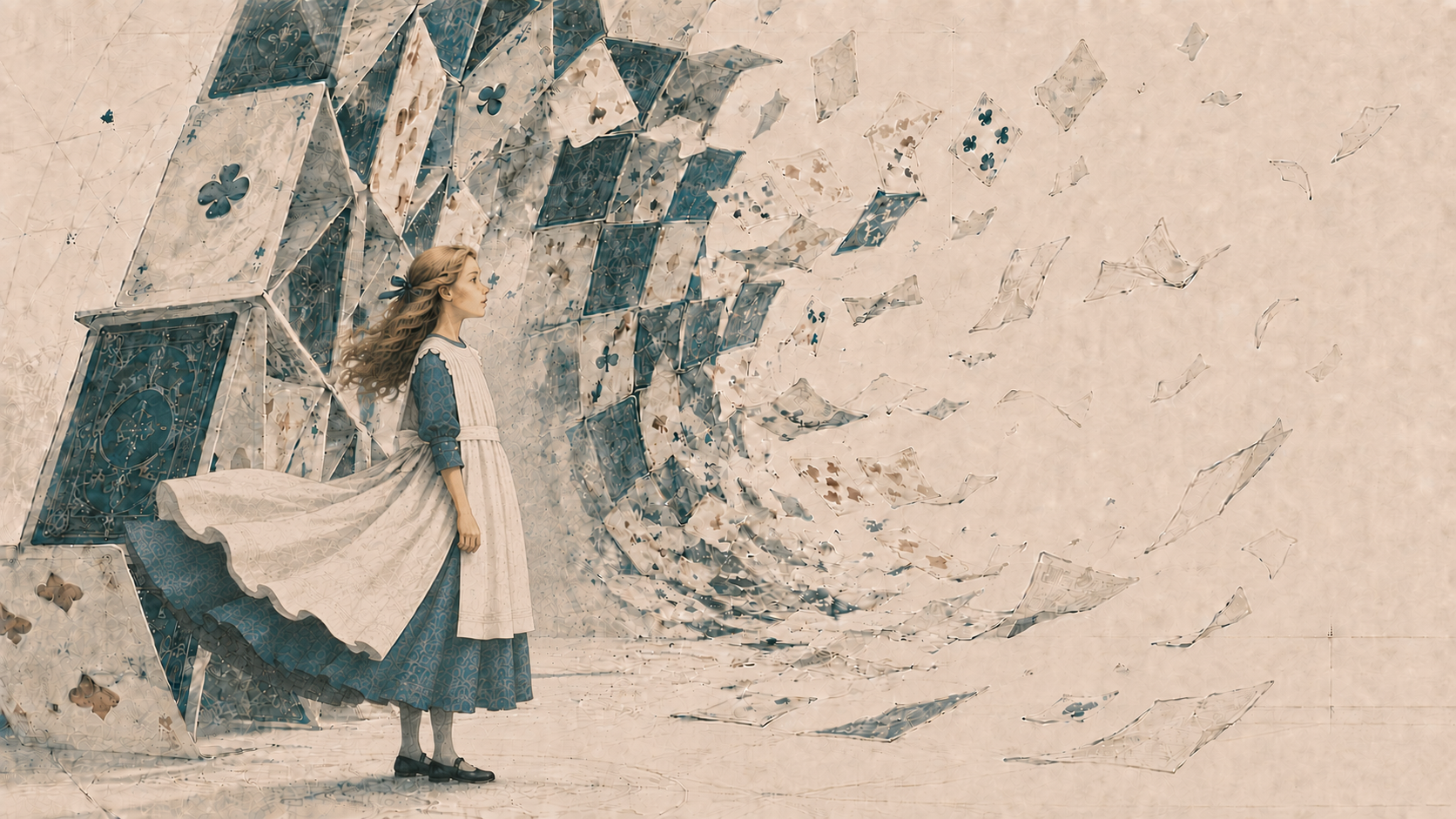
An illustration for an essay on Alice's Adventures in Wonderland and human self-formation.
We do not choose most of the raw material from which we are formed. We enter a world that already exists: we are given a body, a family, a language, a culture, ideas about right and wrong, ways of explaining what happens, and our first models for relating to ourselves and to others. Long before we begin to make deliberate decisions, life is already acting upon us.
Yet circumstances do not produce the same result in everyone. The same experience may unfold in entirely different ways: it may lead to submission, resistance, bitterness, reconsideration, or inner growth. This difference does not, by itself, demonstrate that its cause lies in a person’s capacity to participate in their own formation. But it raises the question of what role a person plays in processing what happens—through perception, meaning-making, relating what happens to their existing understanding, forming decisions, and acting upon them.
Within HSFC, this question can be formulated more precisely: how exactly does a person participate in their own formation, and what do they transform the material they receive into? Do they reproduce acquired ways of thinking and acting? Do they notice the influence of their environment yet continue to act automatically? Or can they recognise the significance of what is happening, reconsider it for themselves, form a position of their own, and change how they act from that point onward?
Alice’s journey makes this question especially visible. At first, change simply happens to her: she grows and shrinks, loses her familiar bearings, and encounters rules she does not understand. But gradually, it is not only her circumstances that change. Alice begins to test other people’s claims, notice contradictions, distinguish confidence from knowledge, and separate status from the right to determine what is true.
Alice’s Adventures in Wonderland is not the source of the concept of Human Self-Formative Capacity (HSFC), nor is it treated here as evidence of the concept’s scientific validity. The book serves as a literary lens through which to explore one of HSFC’s central questions: what distinguishes a change that happens to a person from that person’s active participation in their own formation?
Can Anything Within Us Be Entirely “Our Own”?
At first glance, the boundary between external influence and self-formation seems easy to draw. Whatever has been imposed on a person belongs to the environment; whatever they have chosen independently belongs to them. But under closer examination, that boundary begins to disappear.
We assess what happens through a language we did not create. We rely on ideas that emerged long before us and use ways of reasoning that we once learned from others. Even the desire to free ourselves from another’s influence arises in response to experience we have already received. Often, a person defines themselves in opposition to those they do not wish to resemble and remains bound to them by the very direction of that resistance.
If we regard as our own only what arose within us independently of all external influence, then almost nothing meets the criterion. Our ideas about ourselves, our desires, fears, values, and ways of acting take shape through interaction with the world. Even the inner voice we experience as our own may speak in the words of parents, teachers, culture, or earlier painful experience.
But it does not follow that we are merely the products of the circumstances that formed us. The origin of the material does not yet determine the form it will take. An idea we receive may be reproduced automatically, rejected without reflection, examined, revised, or integrated into a more complex personal understanding.
Authorship, therefore, cannot be reduced to a question of origin: “Did I create this thought entirely by myself?” A more important question is: “What did I do with the thought once it entered my life?” Did I examine it? Did I understand what it was based on? Did I compare it with my own experience? Did I notice its consequences? Did I preserve it, change it, or reject it—and why?
Independence, in this sense, does not mean the absence of influence, but the capacity to change the nature of one’s relationship to it. We do not choose all the material from which we are formed, but we can participate in determining whether that material will automatically reproduce its original content or acquire a different continuation through us.
Yet awareness of where our ideas come from is not enough. A person may understand perfectly well why a particular fear arose, where a destructive way of acting was learned, or whose voice is speaking in an inner judgement—and still continue to act as before. Understanding becomes formative only when it changes one’s subsequent position and way of acting.
This is why what is our own need not be limited to what we created from the beginning. Something received can also become our own when we have recognised it, reworked it, and incorporated it into the way we continue to live—not as the automatic continuation of an earlier influence.
When Other People’s Voices Become Inner Voices
External influence does not remain entirely outside us. Gradually, it enters our inner life and becomes part of how we speak to ourselves, assess what is happening, and regulate our own behaviour. At times, it is no longer possible to say with certainty where a voice once heard from someone else ends and one’s own judgement begins.
Alice finds herself alone in Wonderland, but inwardly she is not alone. She gives herself advice, tries to calm herself, and urges herself not to lose composure. This inner conversation allows her to remain a frightened child while also becoming, for herself, someone capable of offering support, creating order, and providing direction.
This voice was not formed by Alice alone. It carries traces of her upbringing, school rules, acquired ideas about proper behaviour, and the intonations of adults. Yet its external origin does not in itself make it alien or destructive. What we receive from others can become an inner resource: a way of supporting ourselves, maintaining order, and continuing to act when no one else is there.
Self-formation, therefore, cannot be reduced to freeing oneself from every external influence. The question is not whether a voice was borrowed, but what function it serves and whether a person continues to grant it unconditional authority. The same inner voice may help someone regain composure in a difficult situation, or prevent them from feeling; it may remind them of responsibility, or reproduce humiliation.
Alice’s journey is not a movement from what belongs to “others” towards something wholly “her own.” Rather, it is a gradual change in her relationship to what she has already received. She does not stop using the language, knowledge, and rules of reasoning she learned from adults. She begins to distinguish between those that help her understand reality and those that demand she accept absurdity simply because it is expressed with confidence.
The possibility of inner authorship arises not when the voices of others have disappeared from within us, but when none of them remains exempt from scrutiny.“Who Are You?”—Why the Answer We Already Have Is Not Enough
By the time Alice meets the Caterpillar, she has already changed size several times and begun to doubt whether she is still the same person. In the forest, she sees a large blue Caterpillar sitting on a mushroom and silently observing her before asking an exceptionally brief question: “Who are you?”
Alice knows who she was that morning, but after everything that has changed, she is no longer sure that this knowledge is enough. She has not forgotten her name, her family, or her past. She still possesses many facts about herself, yet they no longer restore her former sense of certainty.
We usually answer the question “Who am I?” in terms of our name, origin, occupations, relationships, beliefs, and qualities of character. But all these features can change. If identity is taken to coincide entirely with their sum, then any significant change begins to feel like a threat to the self.
The Caterpillar does not offer Alice a new definition. The question merely reveals the distinction between a description of identity and the person capable of revising that description. A person is not only what has already been formed within them, but also how they relate to it and what they do with it from then on.
Alice’s confusion is not in itself a manifestation of HSFC. Losing an earlier answer may open the possibility of self-formation, but it does not automatically create a new position. Sometimes participation in one’s own formation begins precisely with the recognition that an earlier explanation of oneself no longer corresponds to what is happening.
Yet the space left behind rarely remains empty. When people lose confidence in their own definition of themselves, those around them are quick to offer ready-made answers. In Wonderland, almost every character Alice encounters attempts to tell her something about who she is—and, at the same time, to claim the right to determine the meaning of what is happening. The next question raised by Alice’s journey is therefore different: why should someone else’s certainty be granted authority over the answer?
When What We Observe Conflicts with What Others Tell Us
The conversation with the Caterpillar does not give Alice a ready-made answer to the question of who she is. But gradually, Alice begins to do something more important: she tests what others say against what she is able to observe for herself.
This possibility becomes especially clear in the Duchess’s house. The kitchen is filled with pepper, the cook is hurling dishes, and the baby is continually sneezing and crying. Yet the Duchess explains the child’s reaction as a matter of intention: the child is supposedly doing it on purpose to annoy the adults—and therefore deserves to be treated cruelly.
Alice sees the discrepancy between the Duchess’s explanation and what is actually happening. She does not regard an adult’s authority as sufficient grounds for accepting that adult’s judgement as correct. Seeing the danger the baby is in, Alice forms her own assessment and carries him out of the house.
Here, for the first time, the transition examined through the lens of HSFC becomes particularly clear: Alice does not merely disagree; she relates another person’s claim to observable reality, reaches her own conclusion, and acts upon it. Her decision was not suggested by anyone around her and runs counter to the order accepted in the Duchess’s house.
At the same time, Alice’s judgement does not arise from nothing. It includes ideas about care, danger, and responsibility that she has received from others. But she does not reproduce them mechanically: she applies them to a new situation and acts in a way her surroundings did not require of her.
This is why a person’s own participation cannot be defined by the absence of external sources. It becomes visible in how a person brings received understanding into relation with a particular experience and, through that relation, forms a basis for what they do next.
Later, Alice will face the same task in a far more complex form. She will have to test not merely one adult’s explanation, but an entire system in which the Queen, the court, and its officers jointly determine what is to count as a rule, as evidence, and as guilt.
When Our Own Judgement Stops Asking for Permission
In the Duchess’s house, Alice tests the explanation offered by a single adult. By the end of the book, she is facing an entire system that outwardly bears every mark of legitimate authority: the Queen, the King, the court, the jurors, the witnesses, the rules, and the evidence. Yet each of these elements exists primarily to confirm a decision that has already been made.
During the trial of the Knave of Hearts, rules appear whenever they become useful to those in power. The King attempts to have Alice, who has now grown larger, removed from the courtroom by declaring a new rule to be the oldest in the book. A written text is presented as evidence, although no one knows who wrote it or what it means. The absence of a signature is interpreted not in the defendant’s favour, but as an additional sign of guilt.
Alice no longer confines herself to feeling that something is strange. She examines the court’s claims against the grounds on which they rest. The rule announced by the King appears at precisely the moment when it would allow him to remove her from the courtroom, while his claim that it is ancient is supported by nothing. A document is called evidence even though its origin and meaning are unknown. Punishment is proposed before guilt has been established.
This marks an important change in her position. At the beginning of her journey, Alice tried to discover the rules of this new world so that she could follow them correctly. Now she asks whether the rules themselves deserve recognition. Earlier, not knowing the rules made her doubt herself first; now, a contradiction gives her reason to question the authority behind them.
When the Queen demands that the sentence be imposed first and the verdict reached afterwards, Alice calls the whole proceeding nonsense. She is ordered to be silent, but refuses. At this moment, her own judgement ceases to be merely an inner assessment and becomes a basis for action.
The climactic words “You’re nothing but a pack of cards!” therefore mean more than a sudden burst of courage. Alice comes to see what stands before her differently. Titles, ceremony, and threats no longer compel her to see the cards as an absolute authority. The cards themselves have not changed—her understanding of their significance has, and with it, her behaviour.
Importantly, this conclusion does not arise all at once. Alice has passed through a series of encounters in which confidence took the place of knowledge, status was treated as sufficient grounds, and imposed meaning took the place of observable reality. Each episode gave her material to work with. In the courtroom, that material comes together in a firm judgement: the outward form of authority does not guarantee the truth of its demands.
This is where the transition examined in this essay emerges most fully. At first, experience changed Alice’s circumstances, disoriented her, and compelled her to react. Gradually, she began to recognise a recurring pattern, relate other people’s claims to her own observations, form a position, and act from it.
She did not create the language in which she objected to the Queen. Nor did she invent the distinction between evidence and accusation, or between a rule and an arbitrary exercise of power. But it was Alice who applied the understanding she had received to a new situation, tested what was happening, and refused to continue according to the script she had been given.
Perhaps this is precisely what allows us to call her position her own: it did not emerge free of the world’s influence, but as a result of what Alice did with that influence.What, Then, Truly Belongs to Us?
Alice’s journey does not lead her to a final answer to the question “Who am I?” By the end, she has not arrived at a complete definition of herself, nor has she freed herself from everything she received from adults and from the world around her. Something else has changed: her relationship to other people’s claims to decide for her what is happening and what it means.
What is our own, then, cannot be sought only among thoughts, qualities, or decisions that arose without any external influence. Such a criterion would make inner authorship almost impossible. We think in a language we received, draw on knowledge passed down to us, and are formed within circumstances we did not create.
But neither can everything that arises within a person automatically be considered their own in the deeper sense. An acquired fear, a repeated label, or someone else’s belief may operate from within and be experienced as part of one’s identity while remaining an unexamined continuation of an earlier influence.
The boundary does not lie between what originates outside us and what originates within. It lies between the automatic reproduction of what we have received and our participation in its further transformation.Such participation does not require complete independence from one’s environment, nor does it imply absolute control over the outcome. A person cannot always change their circumstances, undo the effects of what they have lived through, or immediately reconstruct an entrenched way of acting. The possibility of self-formation does not turn every difficulty into a matter of personal blame, nor does it oblige a person to derive growth from every experience of suffering.
But within the possibilities available to them, a person may recognise the significance of what is happening, relate it to their own understanding, examine the explanation they have received, form a position, and translate that position into action. It is these processes taken together—not the mere presence of change, resistance, or strength of character—that allow us to speak of participation in one’s own formation.
HSFC proposes examining differences in people’s capacity to carry out this kind of transformation. In the context of this essay, it is not used to assign Alice a high level of HSFC or to turn a literary narrative into scientific evidence. It provides a language for distinguishing between two processes that may look the same from the outside: a person has been changed by experience—and a person has reworked that experience in a way that changes how they understand and act from then on.
Alice does not cease to be someone formed by the world she came from. She continues to draw on the knowledge, rules of reasoning, and moral ideas she has received. But in Wonderland, she begins to use them for more than meeting other people’s demands. They become material through which she examines the demands themselves.
This is why her final position can be considered her own. Not because Alice created it independently of everything she had lived through, but because she recognised a recurring pattern, formed a judgement, and refused to allow it the same power over her actions.
If life changes us anyway, then perhaps what belongs to us is neither all the material from which we are formed nor complete control over who we become. What may belong to us is our part in what that material becomes: what we recognise, rework, and turn into a basis for how we understand and act from then on.
We do not choose everything that enters our lives. But we can participate in what will continue through us.Conceptual foundation
Human Self-Formative Capacity: HSFC conceptual work →DOI of the HSFC conceptual work ↗