ESSAY · 02
Running to Stay in Place: Does Every Effort Lead to Development?
Alice’s Adventures in Wonderland, Through the Looking-Glass, and the Distinction Between Activity, Adaptation, and Self-Formation
When movement changes our lives — and when it merely allows them to continue
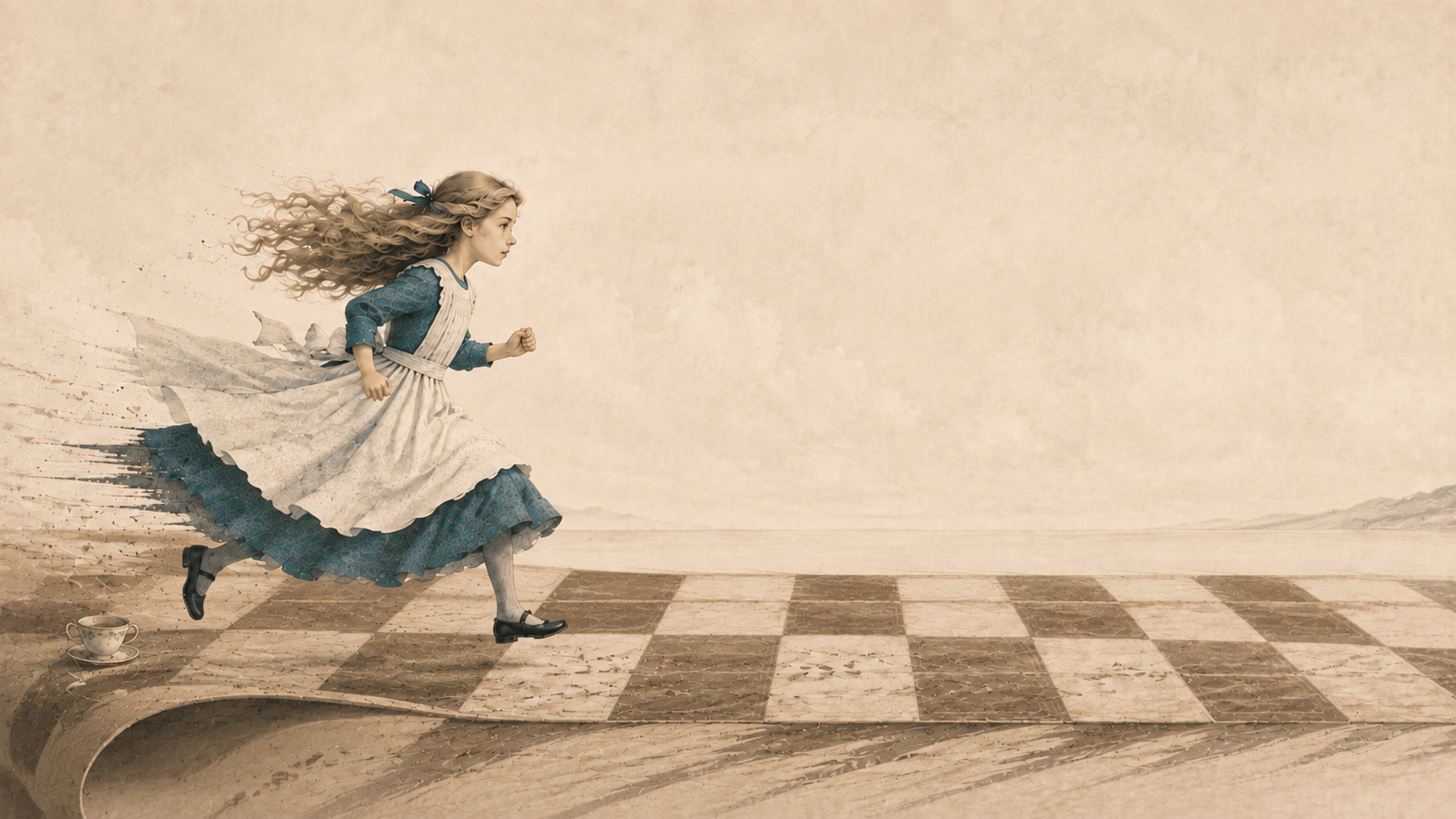
An illustration for an essay on effort, adaptation, and human self-formation.
Movement has a particular persuasiveness. It can be seen, measured, and presented as evidence that a person is not standing still. Completed tasks, acquired skills, difficulties overcome, decisions made, and effort expended create a sense of development: if we act more, faster, and more effectively, then we must be becoming different.
But speed answers only the question of how quickly a person is moving within existing conditions. It tells us nothing yet about whether the direction of their life is changing, whether they are reconsidering the foundations of their own actions, or whether they are participating in who they are becoming. Sometimes considerable effort genuinely transforms a person. Sometimes it merely helps them maintain their previous position in a world that demands ever faster movement.
Not every action is directed toward development in the first place. A substantial part of human effort is necessary simply to sustain life: we need to provide for ourselves, meet obligations, care for others, restore our strength, adapt to changed conditions, and deal with the consequences of difficulties as they arise. These processes should not be considered less important simply because they do not lead to inner transformation. Without them, life itself may become impossible, and the space for further formation may disappear.
Yet the necessity of effort does not determine its formative significance. A person may overcome a difficult situation and return to the same way of life as before. They may become more effective at meeting demands they never chose. They may acquire new skills without changing what they use them for or how they use them. They may remain continuously active while leaving unchanged the very system within which their actions take place.
The distinction, therefore, is not between activity and inactivity, diligence and passivity, or movement and stillness. It lies between different functions of human effort. One action sustains existence. Another restores a lost equilibrium. A third enables adaptation to new environmental demands. And only in some cases are experience and action incorporated into a change in one’s own system of understanding, decision-making, and subsequent behaviour.
Both books about Alice are filled with movement that does not necessarily lead forward. The participants in the Caucus-Race run along an undefined course and are declared winners without any established criterion of victory. The guests at the Mad Tea-Party change places while remaining within the same order. In Through the Looking-Glass, Alice runs as fast as she can and, when she stops, discovers that she is still in the same place.
These episodes differ from one another, but together they allow us to pose a single question: what exactly must change for expended effort to become part of human development?
Lewis Carroll’s books are not used here as a source of the concept of Human Self-Formative Capacity or as evidence of its scientific validity. They serve as a literary lens through which to examine a distinction that is central to HSFC: how do activity, sustaining life, and adaptation differ from a person’s participation in their own formation?
Action by itself does not demonstrate such participation. Nor do exertion, persistence, overcoming obstacles, or an externally visible result. What matters is whether a person transforms the experience they have gained into a change in their own way of understanding and acting — or uses their capacities primarily to continue an already established movement.
When a Successfully Completed Action Is Not Development
At the beginning of her journey, Alice cries so much that an entire pool of tears forms around her. Later, Alice herself, along with a number of animals and birds, finds herself in it. Once they reach the shore, they are all still wet and try to decide how to get dry. After an unsuccessful attempt to do so by listening to a “dry” historical account, the Dodo proposes a more energetic solution — the Caucus-Race.
The race has almost no rules. The participants position themselves along a roughly marked-out course, begin running whenever they choose, and stop at different times as well. About half an hour later, once everyone has dried off, the Dodo declares the race over and announces that all the participants are winners.
The absurdity of the scene can easily obscure an important detail: the race does in fact fulfil its practical function. The participants become dry. Their effort produces a change in their condition, so what happens cannot be described as entirely meaningless or without result.
But the result achieved consists in restoring their ability to continue as before. The participants remedy the immediate consequence of what has happened and end up in a better condition than they were in before the race began, but they do not necessarily become different. The Caucus-Race illustrates not the absence of a result, but the distinction between result and development.
The same can happen outside Wonderland. A person may cope with a crisis, restore a disrupted order, or adapt to increased demands. Such efforts may be essential to life and do not need to be justified by compulsory “growth.” But restoring a lost condition or preserving the ability to function should not automatically be called development.
The problem arises when any act of overcoming difficulty is treated as evidence of inner change. A person may learn to endure more without reconsidering why they should have to endure it, or may restore their capacity to act only to return to the same system of relationships and decisions.
Nor does the declared victory turn the race into development. Since it was never established in advance what would count as progress in the race or by what criterion a winner would be determined, the Dodo’s decision appears only after the race has ended: everyone has won. Fatigue shows that energy was expended, and the prize shows that the result received external recognition. But neither of these tells us what changed in the person’s subsequent way of understanding and acting.
The first limit revealed by the Caucus-Race can therefore be formulated as follows: activity becomes development not because of the amount of effort expended, but because of what, specifically, has changed as a result of that effort.
When Movement Sustains Repetition
At the Mad Tea-Party, movement serves a different function. Here, no one is trying to resolve an immediate problem or restore a lost condition. The Hatter explains to Alice that, after his quarrel with Time, the clock has remained permanently stuck at six o’clock — tea time. Since the tea party never ends, its participants have no opportunity to wash the used dishes. When the cups become dirty, they simply move on to the next seats.
Unlike the Caucus-Race, this movement does not resolve the original difficulty. It merely allows the activity to continue when, under the existing conditions, it would otherwise have to stop. A new place temporarily provides a clean cup, but changes neither the order itself nor the reason why the participants are forced to keep moving.
Alice notices the limit of this system and asks what will happen when they come back to the beginning of the table. She receives no answer: the March Hare suggests changing the subject. Alice’s question exposes what the other participants prefer not to examine. Each successive move is possible, but the sequence as a whole ultimately brings them back to a place that has already been used.
Such repetition can outwardly resemble forward movement. The places change, the cups change, the topics of conversation change, and the participants remain active. Yet the structure of what is happening stays the same. Each new action does not transform it; it merely postpones the point at which continuing in the same way will become impossible.
In a similar way, a person may constantly move on to the next task, obligation, solution, or stage of life without changing the system that keeps producing the same difficulty. They remove the immediate obstacle, create room for the next action, and continue moving. Individual decisions may be reasonable and necessary, yet together they form a closed sequence.
Repetition in itself does not mean the absence of development. Many capacities are formed precisely through repeatedly returning to the same actions. The distinction lies in whether the result of the previous action is incorporated into the next one. If experience is noticed, evaluated, and changes the subsequent way of acting, repetition can become practice. If each new cycle merely reproduces the previous conditions, movement preserves the system but does not transform it.
The participants in the tea party know what they are doing when they change places. They have adapted their behaviour to a world in which Time has stopped and found a way to prolong the existing order. But they do not use the difficulty that arises as a reason to reconsider that order. Their resourcefulness helps them continue, without helping them move beyond repetition.
Alice, too, follows the rules of the tea party for a while. She joins the conversation, tries to understand its logic, moves with the others, and repeatedly corrects contradictions in what they say. But gradually her attitude toward what is happening changes. She is no longer merely reacting to the next remark; she begins to evaluate the very form of interaction itself. Finally, Alice decides that it is the stupidest tea party she has ever attended, gets up, and leaves.
Leaving, by itself, is not necessarily an act of self-formation. A person may leave a situation out of irritation, exhaustion, or a desire to avoid difficulty without changing anything in themselves. But an important distinction appears in Alice’s action: she stops treating continuation as the only possible option simply because everyone else continues. Having recognized the repetitive order and formed her own judgment about it, she changes what she does next.
The Caucus-Race showed that effort can successfully restore a necessary condition without becoming development. The Mad Tea-Party reveals the next limit: activity can sustain movement without changing the structure that makes that movement necessary.
There are situations, however, in which repetition and adaptation cannot simply be abandoned without losing one’s position. Sometimes the environment changes along with the person, and movement becomes necessary not in order to advance, but simply to avoid falling behind. Alice encounters precisely this logic in Through the Looking-Glass, when the Red Queen takes her by the hand and demands that she run faster and faster.
When Effort Is Necessary Merely to Maintain One’s Position
In Through the Looking-Glass, Alice encounters yet another form of movement. The Red Queen takes her by the hand, and they begin running so fast that Alice can barely catch her breath. Yet the surrounding trees and objects do not change their position. When they stop running, Alice discovers that they are still beneath the same tree.
In the ordinary world, running that fast for that long should have taken them somewhere else. But the Red Queen explains that, in Looking-Glass country, it takes all the running one can do to remain in the same place. To get somewhere else, one would have to run twice as fast.
Unlike the Caucus-Race, this effort does not resolve a temporary difficulty. Unlike the Mad Tea-Party, it does not merely prolong an order frozen in time. Here, the environment itself seems to move along with the person: effort is required not to move into a different position, but to preserve one’s relative position within a moving order.
Such a situation requires adaptation. A person has to acquire new knowledge, change the way they work, and respond to demands that did not previously exist. They genuinely become more capable, but the direction of that change is determined to a considerable extent by what is happening around them. The environment sets a new condition, and the person adjusts in order to preserve their ability to function within it.
Yet the ability to meet changing demands does not in itself mean participation in one’s own formation. A person may become increasingly skilled at maintaining a position they never chose. They may master new means without reconsidering the goals those means serve. They may move faster without having the opportunity to ask where that movement is leading.
Self-formation does not require a refusal to adapt. Complete independence from the environment is impossible, and an inability to make necessary adaptations may deprive a person of meaningful opportunities. What matters for self-formation is whether the demand itself becomes an object of reflection: what exactly is it changing in me, why am I accepting this change, and how will the experience I gain affect the way I act in the future?
During the run, Alice chooses neither when the run begins nor the pace at which it proceeds. All her attention is absorbed by the demand not to fall behind the Queen. This reveals one of the most difficult aspects of constant adaptation: the more energy is required merely to maintain one’s position, the less space remains for evaluating the position itself and the direction of movement.
For this reason, the Red Queen’s statement matters not only as an image of an accelerating life. It reveals the limits of visible movement as a criterion of development. We cannot determine whether a person is participating in their own formation simply by looking at how fast they move, how much they learn, or what position they attain. We need to understand what they do with the demands of the environment and what they transform the resulting changes into.
What Turns Change into Participation in One’s Own Formation?
The Caucus-Race solves an immediate problem. The Mad Tea-Party allows a repetitive order to continue. Running with the Red Queen ensures adaptation to a moving environment. In all three cases, activity serves a particular function, but none of these functions is in itself identical to self-formation.
Self-formation cannot be identified by the external form of an action. The same action may sustain existence, respond to environmental demands, and at the same time change the way a person understands what is happening and acts afterward. The distinction is determined not by whether a person continued moving or stopped, but by what they did with the experience they gained.
Across these episodes, we can see different ways in which Alice participates in what is happening. During the Caucus-Race, she joins the proposed activity, although she notices its absurdity. At the tea party, she leaves an order whose continuation she no longer accepts as necessary. In Through the Looking-Glass, during the run with the Red Queen, the movement itself becomes the object of her question: if so much effort has been expended, why have they remained in the same place?
These scenes from the two books do not prove a consistent psychological evolution in Alice or the presence of some fully developed capacity. But when placed side by side, they make it possible to see the distinction between participating in a proposed action and examining where that action leads, why it must continue, and what it changes in the person themselves.
Such a transition does not happen automatically. A person may clearly recognize a repetitive pattern and still continue to reproduce it. They may acquire new knowledge without integrating it into their own system of understanding. They may realize that they are moving in a direction set by someone else and still be unable to change their external circumstances immediately.
Self-formation therefore does not require rejecting external demands. Sometimes a person must continue an action they did not choose. What matters is something else: whether they are able to recognize the function of their effort, relate what is happening to their own understanding, form a position, and on that basis change the way they act thereafter.
Sometimes the result is a new step. Sometimes it is the continuation of a necessary path with a different understanding of its meaning. Sometimes it is a refusal to continue along a trajectory a person no longer recognizes as their own. But stopping by itself does not create one’s own direction. It only opens the space in which such a direction can be formed.
Not Every Effort Leads to Development
The Caucus-Race, the Mad Tea-Party, and the run with the Red Queen show three different functions of effort. It can restore a necessary condition, enable the continuation of an established order, or help a person adapt to a changing environment. All of these actions may be useful, difficult, and necessary. But none of them is, by itself, development.
Development cannot be measured by exhaustion. The amount of energy expended shows the intensity of an action, but not what kind of change it produces in the person. One can run faster, do more, and become more efficient while remaining within a direction that has never been examined or chosen.
But stopping by itself does not create one’s own path either. Refusing to continue may interrupt automatic movement, but a new direction emerges only when a person recognizes what is happening, relates it to their own understanding, forms a position, and changes their subsequent action on that basis.
This is where the distinction that matters for HSFC lies. Not between movement and stillness, activity and inactivity, or adaptation and resistance. It lies between change that helps a person continue along a given trajectory and their participation in determining what that movement will mean and what it will transform them into.
Not every effort, therefore, leads to development. But effort can become material for self-formation when a person does more than expend energy and instead transforms the experience gained into a change in their own way of understanding and acting.
Here, the Red Queen’s formula unexpectedly meets a Russian proverb that expresses an almost opposite idea: “The slower you go, the farther you’ll get.” In the context of this essay, “slower” can be read not as a call to stop or to abandon effort, but as the capacity to move in such a way that speed does not deprive a person of the ability to see the path, assess its direction, and consciously choose what to do next. Sometimes the person who goes farther is not the one who moved fastest, but the one who did not allow speed to obscure direction and retained an understanding of where they were going.
Both formulas can be true at the same time. To preserve one’s position in a changing world, it may indeed be necessary to run as fast as possible. But to move farther, simply doubling one’s speed is not enough. One must preserve the capacity to see the road, understand its direction, and make the next step one’s own.
Conceptual foundation
This essay examines literary episodes through the preliminary conceptual framework of Human Self-Formative Capacity (HSFC).
Human Self-Formative Capacity: HSFC conceptual work →DOI of the HSFC conceptual work ↗